The landscape for today’s pre-teens and early teens is defined by unique pressures. As they navigate a post-pandemic world, increasing academic demands, and the pervasive influence of social media, threats to mental well-being—including isolation and stress—are on the rise. Against this backdrop, the structured, expressive, and relationship-rich environment of high-quality arts programs offers a critical infrastructure for their development.
High-quality youth arts programs do more than provide safe spaces for emotional expression and belonging. Research shows they cultivate “well-becoming”, opening pathways to future opportunities and relationships that last a lifetime. These transformative benefits emerge through structured skill-building, opportunities to create meaningful artwork that centers youth interests, practice toward mastery, opportunities for recognition from families and the broader community, and—critically—developmental relationships fostered by artist mentors and trusted peer communities.
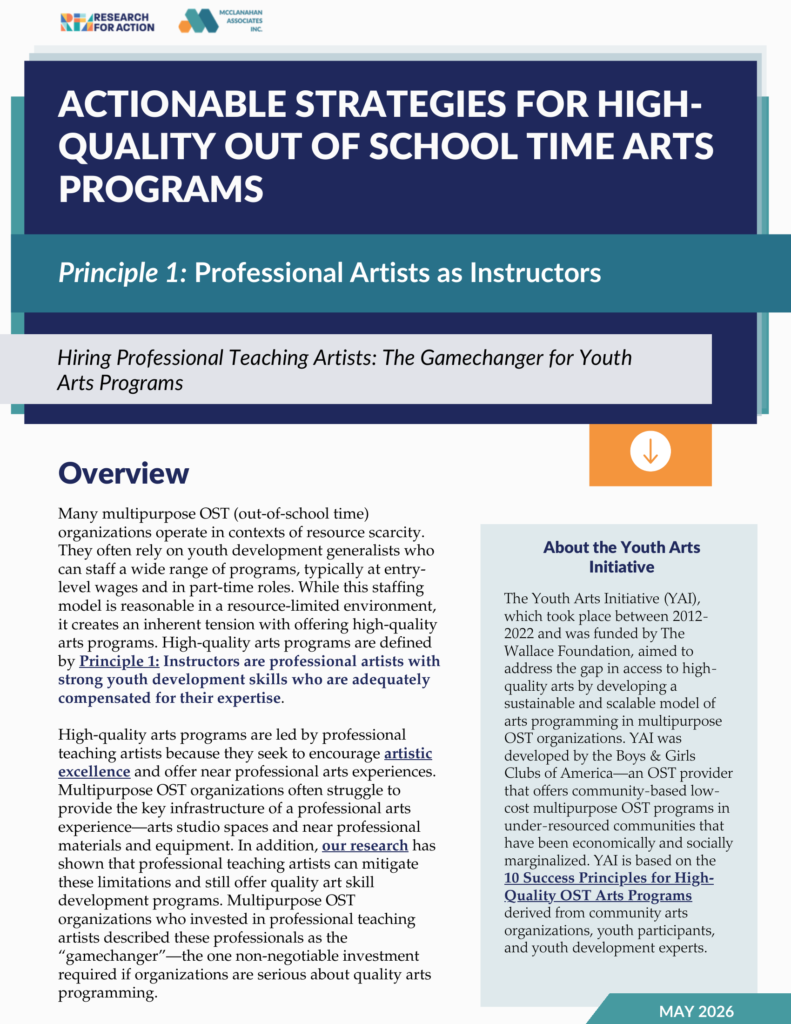
Research from The Wallace Foundation codified key practices for high quality arts programs into 10 Principles for High-Quality Arts Programs, developed in partnership with community arts organizations, youth participants, and youth development experts. More recent studies highlight how culturally centered, community‑based arts organizations deepen this impact by grounding creative practice in youth culture and heritage, allowing young people to explore identity and meaning in affirming ways.
The 10 Principles for High-Quality Arts Programs
- Professional Artists as Instructors: Programs are led by practicing artists, compensated fairly, and supported in their professional growth.
- Executive Commitment: Leaders make a public, sustained commitment to high-quality arts programming.
- Dedicated, Inspiring Spaces: Arts programs take place in welcoming environments that affirm the value of art and artists.
- Culture of High Expectations: Programs respect creative expression and affirm youth participants as artists.
- Culminating Events: Programs conclude with high-quality showcases for real audiences.
- Positive Relationships: Adult mentors and peers foster belonging and acceptance.
- Youth Voice and Leadership: Participants actively shape programs and take on meaningful leadership roles.
- Hands-On Skill Building: Programs emphasize skill development using current equipment and technology.
- Stakeholder Engagement: Programs build networks of support for youth and the arts.
- Safe Spaces: Programs provide physically and emotionally safe environments.
The Challenge of Access
Despite their benefits, community-based youth arts organizations may not be accessible to all. Many are neighborhood-based, limiting participation for youth outside the area who face transportation barriers. Program fees can also restrict access for families with fewer resources. And for youth unfamiliar with the art forms offered, these barriers may discourage exploration altogether.
As a result, too few young people experience the rich developmental opportunities that high-quality arts provide. One solution is to elevate the quality of arts programming within low cost, multipurpose out-of-school time (OST) programs in under-resourced communities. These organizations can expose more young people who might not otherwise have access to art programs to creative opportunities, cultivate sparks of interest, and connect them to community-based arts organizations as their interest and skills grow.
Expanding Equity and Access: Infusing Arts into Traditional Youth-Serving Organizations
To explore how this can be done, we conducted a 10-year study of the Boys & Girls Clubs of America (BGCA) with funding from The Wallace Foundation. The study examined whether BGCA could elevate the quality of its arts programming in their local sites.
Using the 10 Principles for high quality arts programs as a guide, BGCA developed the Youth Arts Initiative (YAI) to integrate high-quality arts into a multipurpose OST setting. Through YAI, BGCA tested whether these principles could be implemented in several of their local sites: multipurpose OST programs located in underserved communities. The research found that they could—but not without challenges. Tensions arose from differing priorities and realities between multipurpose OST programs and community-based arts organizations from which the principles were partially derived.
Yet, despite these challenges, the arts programs engaged middle school youth in powerful ways. Many participants reported little interest in other activities offered at the site, such as sports, academics, leadership and health, prior to YAI. Once involved in high-quality arts programming, they attended more frequently and stayed longer than peers not enrolled in arts programs. Importantly, many had little prior exposure to their chosen art form, but through YAI they developed a “spark” that motivated continued artistic participation and exploration.
Looking Ahead
This blog post launches a series of mini-briefs, in which we will explore each of the 10 Principles in depth, examining why it’s important and offering strategies to implement the principle in a multipurpose OST program.
By elevating arts programming in traditional multipurpose organizations, OST systems can expand equity and access, engage middle school youth, and ignite sparks that last a lifetime.
Stay tuned for the next post in the series!