Keeping the Spark Alive: Building Systems That Support High-Quality Youth Arts Programs

Throughout this mini-brief series, we have explored ten principles that help multipurpose out-of-school (OST) time organizations build and sustain high-quality arts programs. Drawing on lessons from Raising the Barre, Designing for Engagement, and Setting the Stage, we examined what quality looks like in practice, the challenges organizations face in achieving it, and strategies for overcoming those challenges.

One finding stands out across these mini-briefs: high-quality arts experiences matter because they are often the spark that draws young people into deeper engagement. That spark may be a particular art form, an inspiring teaching artist, a welcoming community, or the chance to explore something entirely new. Many youth in our research discovered interests and talents they did not know they had. What kept them engaged was not just the activity, but the relationships, opportunities for mastery, and sense of belonging that high-quality arts programs fostered.

Access to High-quality Arts Experiences Remains Uneven

Community-based youth arts organizations play an essential role in providing high-quality arts experiences. Their artistic expertise and deep connections to local arts communities make them invaluable resources for young people. However, many of these organizations operate on a relatively small scale, and participation fees may place programs out of reach for some families. Multipurpose OST organizations, by contrast, often provide free or low-cost programming and serve large numbers of youth through afterschool and summer programs. As a result, these organizations are uniquely positioned to expand access to high-quality arts experiences for young people who might not otherwise have the opportunity to participate.

This unique positioning is the central premise behind the mini-brief series. Simply offering arts activities is not enough. Multipurpose OST organizations can elevate the quality of their arts programs by investing in the ten principles we explored—from leadership commitment and professional teaching artists to authentic artistic experiences and opportunities for youth performance and recognition.

But our research also points to an important reality: organizations cannot make this shift alone.

High-quality Arts Programming Requires Systems-level Support

Out-of-school time intermediaries can help build the infrastructure that organizations need to succeed by:

  • Connecting multipurpose youth-serving organizations with community-based arts providers, teaching artists, and arts education programs; 
  • Forging partnerships with colleges and universities that are preparing emerging artists and educators;
  • Identifying opportunities for collaboration with media organizations, technology companies, arts supply businesses, and arts funders; and
  • Helping organizations access performance venues, exhibition spaces, and other community resources that elevate young people’s artistic work.

These intermediary organizations can bridge gaps, coordinate resources, and strengthen connections between the OST and local arts ecosystems in ways that no single organization can accomplish on its own.

Funders Have a Critical Role to Play

One of the clearest lessons from our research is that quality costs money. High-quality arts programs require professional teaching artists, specialized equipment and supplies, appropriate spaces, and opportunities for youth to share their work publicly. These investments distinguish high-quality arts programs from basic arts-and-crafts activities, and they are essential to achieving the outcomes communities value for young people.

If we believe that all young people deserve opportunities to explore their creativity, develop their talents, and experience the engagement that high-quality arts programs provide, then we must invest not only in individual programs but in the systems that support them.

The ten principles provide a roadmap for organizations seeking to improve the quality of their arts programming. The next step is ensuring that communities, intermediaries, and funders create the conditions that allow those principles to thrive.

We invite you to access the full mini-brief series, Actionable Strategies for Actionable Out-of-School Time Arts Programs,   by visiting www.researchforaction.org or www.maieval.com. In addition, if you would like to share your experience in funding, building, and sustaining youth arts programming, we invite you to reach out to RFA and MAI. The authors, Tracey Hartmann and Wendy McClanahan, can be reached at thartmann@researchforaction.org and wmcclanahan@maieval.com.
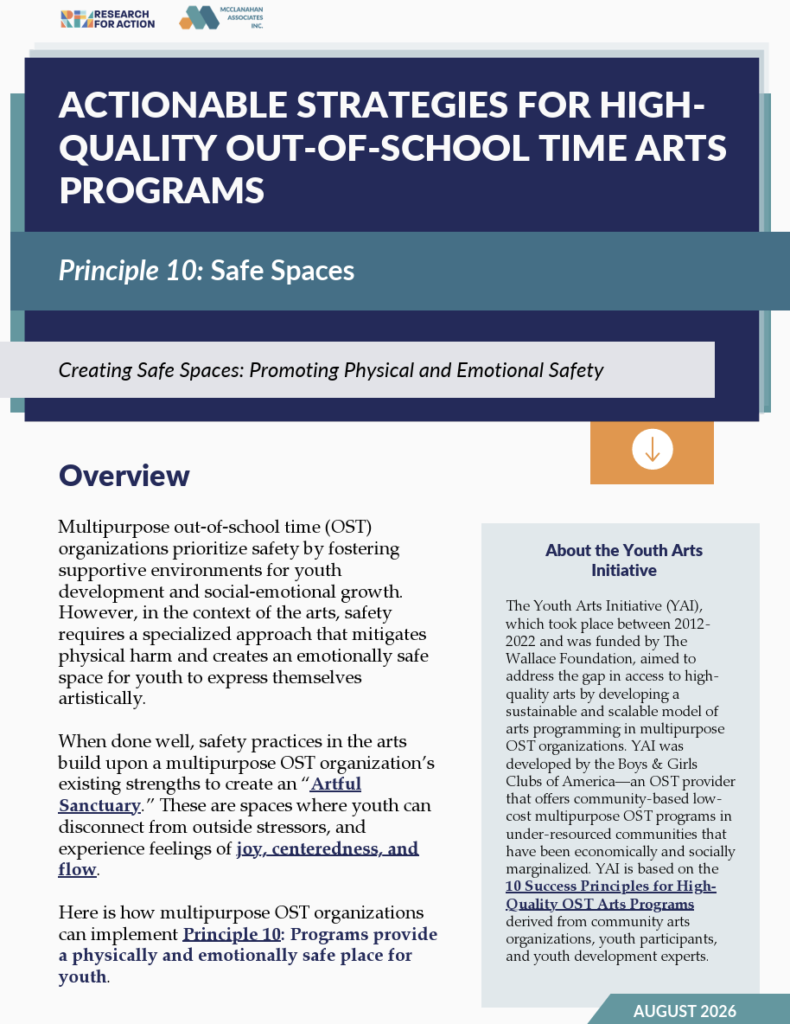

Download the 10th mini brief below

Huiyao Chen

Research Assistant Intern

Huiyao Chen is a Research Assistant Intern at MAI. She is a graduate student in Applied Developmental Psychology at the University of Pittsburgh. Her academic interests focus on evaluating educational programs, community-based organizations, and support services for children with special needs. Huiyao is also interested in how environmental factors shape children’s psychological development. She has worked on projects related to education policy evaluation, service design for children with Tourette syndrome, and community organization improvement. Outside of work, Huiyao enjoys films and reading science fiction, mystery, and horror novels.

Rebecca Reumann-Moore

Qualitative Evaluation Consultant

Rebecca Reumann-Moore is an independent consultant and Qualitative Evaluation Consultant with MAI. Rebecca’s areas of expertise include program evaluation and policy research, qualitative and mixed-methods research, and capacity-building and technical assistance for non-profits. Rebecca has deep expertise in education, with a focus on increasing educational equity. She has also worked with clients and non-profits working in a wide range of other areas, including health and wellbeing, child welfare, youth development, social services, and arts and culture.

Rebecca earned a Ph.D. in education from the University of Pennsylvania. Before becoming a consultant, she worked for many years at Research for Action (RFA), where she was a Senior Research Associate and the Director of Qualitative Research. At RFA, she honed her expertise in all stages of the research process and in communicating results in a range of ways. In evaluation and technical assistance processes, she values collaboration with colleagues, clients, and community members. She works closely with clients to understand their needs in order to design or co-design research, evaluation, and technical assistance approaches and processes that fit each client’s unique context.

Outside of work, she enjoys spending time with family and friends, outdoor activities, reading, travel, and music.

Kyonne Isaac

Evaluation Consultant

Kyonne Isaac is an Evaluation Consultant with MAI. Kyonne has spent over a decade crafting successful social impact programs and leading strategic business planning for nonprofits as a director, consultant, and impact evaluator. Successful projects include restructuring the business and finance operations for Philadelphia’s oldest urban farm into a profitable operation to overcome its debts; and more recently, leading the strategic expansion of Habitat for Humanity’s community engagement for the homeownership and home repair programs in Philadelphia. This work resulted in tripling the number of families served annually over the course of two years and crafting a human-centered framework for evaluating the success of their home repair program. Kyonne’s approach to evaluation and coaching includes leveraging existing relationships with community leaders already embedded in the community, applying dynamic communication practices, and practicing an increased sensitivity to a population’s needs to craft custom methods for connection and collaboration for clients seeking equitable, sustainable growth.

Before moving to Philadelphia, Kyonne received formal training in qualitative and quantitative research methods, earning her bachelor’s degree in psychology with honors from Stanford University and her master’s degree in social psychology & social policy from Princeton University under a fellowship with the National Science Foundation. Her work has often centered on investigating the experiences of historically-marginalized communities. In between her bachelor’s and master’s degrees, she worked as a research scientist at the University of California, Berkeley, and as project manager for the World Bank, where she conducted focus groups and survey research for a pilot program training young adult entrepreneurs looking to build agricultural “green” businesses with a social impact in Uganda.

Kyonne is an avid gardener and advocate for the benefits of time in nature. Outside of her research work, she coaches community gardeners in leadership and community engagement; and In 2019, she was appointed to the steering committee responsible for the City of Philadelphia’s first-of-its-kind Urban Agriculture Plan, “Growing from the Roots”.

Don Haworth

Administrative Coordinator

Don Haworth is MAI’s Administrative Coordinator, supporting grants management, accounting, and office operations. Prior to joining MAI, Don worked for Prince George’s County, Maryland, for over twenty years as a firefighter/paramedic, and served in the U.S. Air Force. Don has a long history of volunteer community service, including serving as a volunteer with Boy Scouts of America, participating in and leading several community groups, and was a volunteer firefighter. When he is not working at MAI, Don teaches martial arts and skiing/snowboarding.

Sarah Pepper

Statistical Consultant

Sarah Pepper serves as a Statistical Consultant with MAI. Over the past 25 years, she has worked with a wide range of non-profit organizations and foundations to facilitate the design of data collection and analysis approaches and to help organizations strategize around manageable ways to monitor their fidelity to intended implementation efforts and anticipated outcomes.

She enjoys the experience of continually learning from each organization with which she has the pleasure to work. Sarah is grateful for the opportunity to jointly create evaluation tools and processes that are mutually beneficial to participants and practitioners.

Prior to working with MAI, Sarah worked with Public/Private Ventures as a Research Associate. She earned a Ph.D. in Demography and Sociology from the University of Pennsylvania.

Sarah lives outside of Philadelphia where she enjoys officiating track meets, making new vegetarian recipes, and keeping up with the adventures of her adult children.

Sara Greenfield

Research Associate

Sara Greenfield is a Research Associate at MAI. In her capacity as a Project Manager, Sara has led and overseen numerous diverse projects at MAI. Her experience extends across a spectrum of sectors, including social, health, education, and environmental justice. Sara also brings valuable experience in evaluating learning networks and communities of practice.

Sara is a mixed-methods researcher and is committed to applying a racial equity lens and cultural humility to all of her evaluation work. She is dedicated to gathering nuanced, systematic information about program implementation, constituent voices and experiences, programmatic outcomes, and areas of opportunity. Sara’s passion infuses depth and inclusivity into her evaluation work, ensuring a comprehensive understanding of diverse perspectives and advancing equity within her projects.

Sara, a first-generation Latina college graduate, earned her B.A. in Psychology and Cognitive Neuroscience from Temple University.

Sara, her husband Cliff, and two kiddos enjoy exploring outside, cooking and baking together, reading, and doing puzzles!

Wendy McClanahan

President/CEO

Wendy McClanahan is McClanahan Associate’s (MAI) President/CEO. Wendy uses her research and evaluation expertise to help programs, initiatives, and organizations maximize their impact, improve their practice, and fuel systemic change. Her approach centers the expertise and assets of the organizations she works with and the people they serve.

Over her career, Wendy has led studies of out-of-school time and mentoring programs, violence and crime reduction programs, health equity initiatives, and employment and training programs. She also works with organizations to help them grow their evaluation and learning capacity.

Prior to forming MAI, Wendy was senior vice president for research and evaluation at Public/Private Ventures. She has a PhD in Criminology from the University of Pennsylvania and a MS in Human Development from Penn State. 

Wendy lives in the Philadelphia area and enjoys hanging out with her family and friends, playing games, and doing things that get her outside, like skiing and (leisurely) swimming (also known as “floating”).

“My approach to equitable research and evaluation is deeply informed by both my professional expertise and my personal experiences.

Growing up in a family with diverse socioeconomic and cultural roots and later raising a multiracial family has cultivated a profound understanding of varied pathways and the systemic forces that shape opportunity.

This lived experience, which includes navigating the collateral impact of the justice system on families, strengthens my commitment to research that not only rigorously analyzes data but also authentically centers lived experiences and drives actionable change for youth and families.” – Wendy McClanahan